
Golden ratio vs rule of thirds
Both put your subject off-center for a more balanced photo. The difference is where the lines fall, and whether you follow straight lines or a curve.
Where the lines fall
The rule of thirds splits the frame into three equal parts: lines at one third and two thirds (33% and 67%). The golden ratio (about 1 : 1.618) splits it unequally: lines at about 38% and 62%. This version is often called the phi grid. The golden ratio lines sit a little closer to the middle.
The golden ratio grid on a photo
Use it exactly like the rule of thirds: put the subject on a line or a crossing. Because the crossings are nearer the center, the subject feels a bit more central and the photo a bit tighter.


The golden spiral
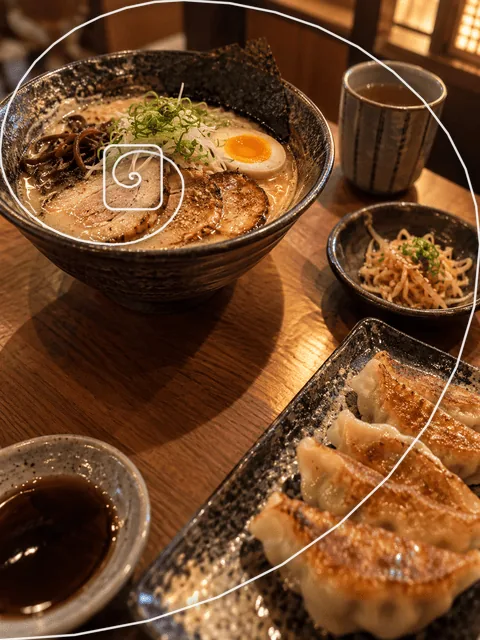
The golden spiral is a curve built from golden-ratio rectangles. It suits scenes with a natural curve, such as a bowl, a staircase, a coastline or a curled-up pet. Put the subject at the tight end of the spiral and let the rest of the scene follow the curve.

Which one should you use?
- Start with the rule of thirds. It is in every phone's grid, easy to see and close enough to the golden ratio that most viewers can't tell them apart.
- Try the golden ratio when thirds feel too far out, for example in portraits where you want the person a little nearer the center.
- Use the spiral only when the scene already has a curve. Forcing it onto straight lines rarely helps.
Beginner Cam has all three as guides (Rule of thirds, Golden ratio and Golden spiral), and you can switch between them on the live camera to compare. Learn more in rule of thirds on your phone.